The DMP Programmer's Manual
The Digital Motion Processor in the InvenSense MPU-6050 family (MPU-6050, MPU-6500, MPU-9150, MPU-9250) and, as DMP3, in the ICM-20948: its architecture, memory, instruction set, host interface and assembly language.
Project maintained by jabezwinston Hosted on GitHub Pages — Theme by mattgraham
3. Programmer’s Guide
This chapter describes the instruction set by class. Chapter 4 summarizes every instruction in tables, and Chapter 5 defines each one in full.
Unless an example is a whole program, it runs in the definitions harness. On entry, the harness leaves the machine as follows:
| State | Harness value |
|---|---|
| P0 | 0x100 |
| P1 | 0x110 |
| P2 | 0x120, word 0 |
| mode | fmode 1 |
| predicate | none armed |
| route | RAM (store) |
The harness ends the example with end. The ; given and ; expect comments are machine-checked
(Chapter 8).
3.1 Instruction Formats
Almost every instruction is one byte. The two exceptions are the F4 forms (a branch, jump or call target, or an interrupt code) and, on DMP3, the FC compare and the FD shift.
Table 3-1. Instruction formats
| Class | Format | 7 | 6 | 5 | 4 | 3 | 2 | 1 | 0 | Hex | Instructions |
|---|---|---|---|---|---|---|---|---|---|---|---|
| Arithmetic and logic | ALU | 0 | A | B | adv | op | 00–7F | under f1–f3: add rsub mul nmul · f0: mac macn · f5–f7: clamp cmp and xor | |||
| one-byte branch (MPU, mode 4) | 0 | 0 | d | 00–3F | branch.m4: to its own address + 1 + d (d signed) | ||||||
| branch target (DMP3, mode 4) | 0 | call | t | 00–7F | the high byte of a jump.m4 (call = 0) or call.m4 (call = 1); the next byte is t[7:0] | ||||||
| Pointer control | page | 1 | 0 | P | page | 80–AF | p0page p1page p2page (P = 0, 1, 2) | ||||
| bank | 1 | 0 | 1 | 1 | P | bank | B0–BB | p0bank p1bank p2bank (P = 0, 1, 2) | |||
| block | 1 | 0 | 1 | 1 | 1 | 1 | P | BC–BF | p0blk p1blk p2blk (P = 0, 1, 2); P = 3: DMP3 movz, reserved on the MPU | ||
| Data transfer | move | 1 | 1 | 0 | 0 | x | k | adv | C0–CF | mov (x = 0), movx (x = 1): from P0's word k | |
| Control | D group | 1 | 1 | 0 | 1 | fn | D0–DF | p2inc2 test · MPU: clear aliases d2–d7 · DMP3: lo lo.next load · always if store fifo clr clr.next | |||
| E group | 1 | 1 | 1 | 0 | fn | E0–EF | MPU: clear aliases · DMP3: ret (E0), int (E2), clear alias (E7) | ||||
| Mode and flow | mode | 1 | 1 | 1 | 1 | 0 | m | F0–F7 | fmode m (m ≠ 4) · F4 enters mode 4 and is the branch / jump / call prefix | ||
| increment | 1 | 1 | 1 | 1 | 1 | 0 | adv | dec | F8–FB | inc dec inc.next dec.next | |
| system | 1 | 1 | 1 | 1 | 1 | 1 | fn | FC–FF | MPU: xchg01 xchg02 int · DMP3: the cmp.cond and shift prefixes · end (FF) on both | ||
Table 3-1a. Multi-byte forms
| Core | Instruction | Byte | 7 | 6 | 5 | 4 | 3 | 2 | 1 | 0 | Hex | Meaning |
|---|---|---|---|---|---|---|---|---|---|---|---|---|
| MPU-6050 | branch | 1 | 1 | 1 | 1 | 1 | 0 | 1 | 0 | 0 | F4 00–3F | to the F4's address + 2 + d, d a signed 6-bit displacement |
| 2 | 0 | 0 | d | |||||||||
| MPU-6050 | int.f4 | 1 | 1 | 1 | 1 | 1 | 0 | 1 | 0 | 0 | F4 41–7F | n with a non-zero low five bits: raise DMP_INT; F4 40: nothing (nop.f440); F4 60: reserved |
| 2 | 0 | 1 | n | |||||||||
| MPU-6050 | nop.f4 | 1 | 1 | 1 | 1 | 1 | 0 | 1 | 0 | 0 | F4 + byte ≥ 80 | one byte: enters mode 4; the next byte is the next instruction |
| ICM-20948 | jump / call | 1 | 1 | 1 | 1 | 1 | 0 | 1 | 0 | 0 | F4 00–7F xx | to t, absolute; call = 1 pushes the address after the instruction |
| 2 | 0 | call | t13–t8 | |||||||||
| 3 | t7–t0 | |||||||||||
| ICM-20948 | mode4 | 1 | 1 | 1 | 1 | 1 | 0 | 1 | 0 | 0 | F4 + byte ≥ 80 | one byte: enters mode 4 |
| ICM-20948 | cmp.cond | 1 | 1 | 1 | 1 | 1 | 1 | 1 | 0 | 0 | FC C0–C3 xx | F := (P1 word k & 0x3F) cond t, cond c = 0 ==, 1 >, 2 <, 3 ≠ |
| 2 | 1 | 1 | 0 | 0 | 0 | 0 | k | |||||
| 3 | t | c | ||||||||||
| ICM-20948 | shl / sar | 1 | 1 | 1 | 1 | 1 | 1 | 1 | 0 | 1 | FD 01–7F | r = 0: shl s (s = 1–31); r = 1: sar 32 − s (s = 0 gives sar 32) |
| 2 | 0 | adv | r | s | ||||||||
The ALU byte
A byte below 0x80 is an ALU instruction, except in mode 4 (§3.8). Its fields:
- A (bits 6–5) selects word A of P0’s page.
- B (bits 4–3) selects word B of P1’s page.
- adv (bit 2) advances P2.w before the store.
- op (bits 1–0) selects the operation. The mode register says what the four operations are:
Table 3-2. The ALU byte’s operation, by mode
| op field | fmode 0 |
fmode 1–3 |
fmode 5–7 |
|---|---|---|---|
0 (00) |
mac | add | clamp |
1 (01) |
macn | rsub | cmp |
2 (10) |
mac.m | mul | and |
3 (11) |
macn.m | nmul | xor |
Under fmode 0, op 2 and op 3 repeat op 0 and op 1. The assembler names them mac.m and
macn.m.
    0x2C = 0 01 01 1 00   A = 1, B = 1, adv, op 0   under f1: add 1,1,inc
                                                     P2.w += 1;  M[P2] := M[P0+4] + M[P1+4]
    0x69 = 0 11 01 0 01   A = 3, B = 1, op 1        under f1: rsub 3,1
                                                     M[P2] := M[P1+4] - M[P0+12]
3.2 Arithmetic
| Instruction | Result r | Stored |
|---|---|---|
add A,B |
A + B | r, wrapped |
rsub A,B |
B − A | r, wrapped |
mul A,B |
⌊A·B / 2³⁰⌋ | r, wrapped |
nmul A,B |
⌊−A·B / 2³⁰⌋ | r, wrapped |
- F is the sign of the exact result, before it wraps.
- R, the result register, takes the exact result. After
mulandnmulit holds the whole 64-bit product. - The store goes through the route: to M[P2 + 4·P2.w] in RAM, or to the FIFO.
        ; given 0x100 = 1.0q
        ; given 0x110 = 1.5q
        add     0,0             ; 1.0 + 1.5 = 2.5 wraps to -1.5
        ; expect 0x120 = -1.5q
        ; expect F = 0
        ; given 0x100 = 7i
        ; given 0x110 = 100i
        rsub    0,0             ; 100 - 7, as integers
        ; expect 0x120 = 93i
RSUB and −2.0. RSUB computes B + (−A) with −A wrapped to the word, or to the lane under a lane mode. For A = 0x80000000 (−2.0 in Q30), −A wraps back to 0x80000000. RSUB then adds, and F is the sign of that sum. Every other A gives the true sign of B − A.
Integers and multiplication
ADD, RSUB, INC and DEC compute the same bits whether the words are integers or Q30 (§2.7). Multiplication keeps the high bits, ⌊A·B / 2³⁰⌋, which is right for two Q30 operands:
        ; given 0x100 = 0.5q
        ; given 0x110 = -0.25q
        mul     0,0
        ; expect 0x120 = -0.125q
For integers, use one of the following:
| To compute | Use |
|---|---|
| x · K, K a constant | doublings and additions (Horner’s rule): 10x = 2(2(2x) + x) |
| ⌊x / 2^k⌋ | mul by the word 2^(30−k): an exact arithmetic right shift |
| x · y on DMP3 | mul, then shl 30 (stores x·y mod 2³²) |
| x · y on the MPU-6050 | a shift-and-add loop (§9.9) |
        ; x * 10 by doublings: P0, P1 and P2 on one page {x, t}
        ; given 0x100 = 37i
        p1page  0
        p2page  0
        add     0,0,inc         ; t := 2x
        add     1,1             ; t := 4x
        add     1,0             ; t := 5x
        add     1,1             ; t := 10x
        ; expect 0x104 = 370i
        ; floor(x / 2) as a multiplication by 2^29
        ; given 0x100 = -7i
        ; given 0x110 = 20000000
        mul     0,0
        ; expect 0x120 = -4i
        ; DMP3: the integer product in two instructions
        ; given 0x100 = 1234i
        ; given 0x110 = -567i
        mul     0,0             ; R := the whole product; the shifter is loaded from R
        shl     30              ; store (R's word << 30) | R's low 30 bits
        ; expect 0x120 = -699678i
Multiply-accumulate
Under fmode 0 an ALU byte adds its product to R (mac) or subtracts it (macn), then stores
⌊R / 2³⁰⌋.
- Precision. R is 64 bits wide and holds Q60 values in [−8, 8). The products are summed exactly and floored only when stored.
- Overflow. R wraps modulo 2⁶⁴, and the stored word wraps modulo 2³².
- F is the sign bit of R.
What starts a sum:
| Event | MPU-6050 | ICM-20948 |
|---|---|---|
An op that writes R: add, rsub, mul, nmul, inc, dec, clamp (its compare D), DMP3 load and shifts |
replaces R | replaces R |
A P2 move: page or bank load, p2inc2, clr.next, any advancing form |
R := 0 | R kept |
A MAC op with adv |
R := 0, then ± A·B | R := ± A·B |
| The end of a pass | R kept | R kept |
On the MPU-6050 the move’s R := 0 is the whole restart. A MAC after a move and then an inc,
dec or clamp adds to their result:
        ; given 0x100 = 0.5q
        ; given 0x110 = 0.5q
        ; given 0x120 = 1.0q
        p2page  2               ; a move: R := 0
        inc                     ; R := 1.0 + 1 lsb, stored
        fmode   0
        mac     0,0             ; R := R + 0.25
        ; expect 0x120 = 50000001
The safe way to begin a sum on either core is to compute its first term with mul. MUL replaces R
with the whole product, and the following MACs add to it exactly:
        ; a three-term dot product: 0.5*0.5 + 0.25*0.5 + 1.0*0.25
        ; given 0x100 = 0.5q, 0.25q, 1.0q
        ; given 0x110 = 0.5q, 0.5q, 0.25q
        mul     0,0             ; R := 0.25 (fmode 1)
        fmode   0
        mac     1,1             ; R := 0.375
        mac     2,2             ; R := 0.625; stored at 0x120
        ; expect 0x120 = 0.625q
Increment and decrement
inc and dec add or subtract one LSB of the lane to the destination word M[P2]:
- the low half-word under
fmode 3andfmode 7; - the high half-word under
fmode 2andfmode 6; - otherwise the whole word.
inc.next and dec.next advance P2.w first. F is the sign of the exact result, and R takes the
result.
        ; given 0x120 = 41i, 1234ffff
        inc                     ; a counter
        fmode   3
        inc.next                ; the low lane wraps; no carry into the high half
        ; expect 0x120 = 42i, 12340000
Where the result goes depends on the route:
| Route | MPU-6050 | ICM-20948 |
|---|---|---|
RAM (store) |
M[P2] := the result | M[P2] := the result |
FIFO (fifo) |
emits M[P2] ± 1 as a new FIFO item, of the lane’s width; RAM is unchanged | changes the last word already in the FIFO; under a lane mode the result is undefined |
Lanes
        ; given 0x100 = 00010005
        ; given 0x110 = 0002fffe
        fmode   3
        add     0,0             ; low lanes: 5 + (-2) = 3; the high half of 0x120 is kept
        fmode   2
        add     0,0,inc         ; high lanes: 1 + 2 = 3, into word 1's high half
        ; expect 0x120 = 00000003, 00030000
The product’s low word and the shifter (DMP3)
lo stores R’s low 30 bits, sign-extended from bit 29. After a mul, that is the low part
of the product; after a MAC run, the low part of the sum. lo.next advances P2.w first.
        ; given 0x100 = 01234567
        ; given 0x110 = 89abcdef
        mul     0,0             ; the high part:  fde578db
        lo.next                 ; the low part:   094e4629
        ; expect 0x120 = fde578db, 094e4629
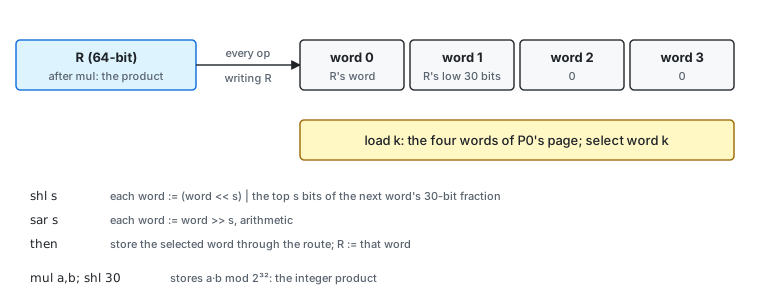
Figure 3-3. The DMP3 shifter
The shifter is a four-word register.
- Loaded from R. Every instruction that writes R loads it: word 0 is R’s word, word 1 is R’s low 30 bits, and words 2 and 3 are 0.
load kfills it from the four words of P0’s page instead, and selects word k for storing.shl sshifts every word left by s, pulling in the top s bits of the next word’s 30-bit fraction.sar sshifts every word right, arithmetically.
Both shifts then store the selected word through the route, and R takes that word.
        ; given 0x100 = -7i, 0.5q
        load    0
        sar     1               ; -7 >> 1 = -4
        load    0
        shl     1,adv           ; (-7 << 1) | the top bit of word 1's fraction (0.5) = -13
        ; expect 0x120 = -4i, -13i
3.3 Logic and Compare
Under fmode 5, fmode 6 and fmode 7, the ALU byte is a logic operation, on the whole word or
on one lane:
| Instruction | Result | F | R |
|---|---|---|---|
clamp A,B |
A clamped to [−B, B]: A ≥ 0 ? min(A, B) : max(A, −B), wrapped | A was clamped | D = (A ≥ 0 ? B − A : A + B) |
cmp A,B |
nothing stored | A < 0 ≤ B | unchanged |
and A,B |
A AND B | unchanged | unchanged |
xor A,B |
A XOR B | unchanged | unchanged |
        ; given 0x100 = 1.5q, -1.5q
        ; given 0x110 = 1.0q
        fmode   5
        clamp   0,0             ; 1.5 -> 1.0
        clamp   1,0,inc         ; -1.5 -> -1.0, into word 1
        ; expect 0x120 = 1.0q, -1.0q
        ; expect F = 1
- CLAMP and
test. CLAMP leaves its internal compare D in R, so atestafter it asks whether A sat exactly on its bound. cmpis not a compare. It is a sign test: F is set only when A is negative and B is not.- OR and NOT. There is no OR or NOT. a OR b = (a XOR b) XOR (a AND b), and NOT a = a XOR −1.
test
test sets F := (R’s word = 0). Under a lane mode it looks only at that lane, the one in force
when test runs. R holds the last arithmetic result, so test after an rsub tells whether the
operands were equal. Two things to keep in mind:
- AND, XOR and the sign test do not write R. A
testafter them repeats the earlier answer. - On the MPU-6050 a P2 move between the arithmetic and the
testzeroes R.
Comparisons
There is no compare instruction. Subtract with rsub into a scratch word and read F:
| Test | RSUB operands | Then |
|---|---|---|
| x > y | A = x, B = y (computes y − x) | if f |
| x ≤ y | A = x, B = y | if nf |
| x < y | A = y, B = x | if f |
| x ≥ y | A = y, B = x | if nf |
| x = y, x ≠ y | either order, then test |
if f, if nf |
        ; given 0x100 = 5i
        ; given 0x110 = 3i
        rsub    0,0             ; 3 - 5 < 0: F says x > y
        ; expect F = 1
F is the sign of the exact difference, so a comparison never overflows. The one exception is an A operand of 0x80000000, which RSUB adds (§3.2). When x can be 0x80000000, first test for that value: RSUB with A = 0x80000001 and B = x gives F = 1 exactly when x = 0x80000000. Chapter 9 shows the guarded form.
Immediate compare (DMP3)
cmp.eq k,t, cmp.gt k,t, cmp.lt k,t and cmp.ne k,t set F from the low 6 bits of P1’s word
k, compared unsigned against the constant t (0–63).
- They store nothing, and they leave R unchanged.
- They set F even while a predicate is armed.
- They are three bytes and take no constant word from memory.
        ; given 0x110 = 10i
        cmp.eq  0,10
        ; expect F = 1
3.4 Data Transfer
| Instruction | Effect |
|---|---|
mov k |
P0’s word k, through the route |
movx k |
P0’s word k with its half-words exchanged, through the route |
clr |
0, through the route, to the current word |
clr.next |
advance P2.w, then 0 |
MOV and MOVX respect the lane: under fmode 2 only the high half is written, under fmode 3 only
the low half, and a lane routed to the FIFO is 2 bytes. Neither one touches F or R.
        ; given 0x100 = 12345678
        ; given 0x120 = c0ffee00, 00000005
        fmode   2
        movx    0               ; the source's low half into the destination's high half
        fmode   1
        p0page  2               ; P0 -> 0x120
        movx    1,inc           ; 00000005 -> 00050000, into word 1
        ; expect 0x120 = 5678ee00, 00050000
- Emitting a value. Set the route to the FIFO, then
movthe word. An arithmetic op emits its result the same way. - Copying from P1’s page. MOV reads only P0, so add a zero word with
add. - The clear aliases.
clr(0xDE) andclr.next(0xDF) are the clear instructions. The MPU-6050 also clears on 0xD2–0xD7 and 0xE0–0xEF, and the ICM-20948 on 0xE7. Those aliases cost as much as an add. movz(DMP3) toggles a latch. While it is set, a MOV stores a value that depends on the FIFO instead of its source. That value is not reliable, so do not usemovz.
        ; given 0x100 = 0.25q
        fifo
        mov     0               ; emit one word
        ; expect fifo = 10000000
3.5 Pointer Control
| Instruction | Effect |
|---|---|
p0page n, p1page n, p2page n |
the pointer’s page := n; p2page also sets P2.w := 0 |
p0bank n, p1bank n, p2bank n |
the pointer’s bank := n |
p0blk, p1blk, p2blk |
the pointer’s block += 1 (MPU modulo 3, DMP3 modulo 4) |
p2inc2 |
P2.w += 2 |
xchg01 (MPU) |
toggle: the A operand and MOV read through P1, the B operand through P0 |
xchg02 (MPU) |
toggle: the A operand and MOV read through P2, and stores go to P0’s page |
Reaching a destination word. From a fresh p2page:
| Word | How |
|---|---|
| 0 | store directly |
| 1 | an advancing form (add A,B,inc, mov k,inc, inc.next), or clr.next (which clears it) |
| 2 | p2inc2, or two advances |
| 3 | p2inc2 and an advancing form |
There is no NOP. Every byte changes some state:
| Byte | What it changes |
|---|---|
p2page n |
P2 and P2.w; on the MPU-6050, also R |
fmode m |
the mode register |
always |
the predicate |
store, fifo |
the route |
Pad only with bytes whose effects are harmless at that point in the program.
The MPU-6050’s exchanges last until the same instruction toggles them again, or until the end of
the pass. xchg01 reverses a subtraction without reloading pointers: after it, rsub A,B computes
P0’s word B minus P1’s word A.
3.6 Routing and Predicates
The route.
storesends every following result to memory at P2;fifosends it to the FIFO.- The route stays until the other instruction is executed, and carries over into the next pass.
- After DMP_RST it is RAM.
Predicates.
if farms a predicate that runs instructions only while F is set;if nfruns them only while F is clear.if f.alt(0xDB) behaves asif f.- A predicate stays armed until the next
always,if f,if nforif f.alt. - An instruction the predicate skips costs one cheap cycle count per byte (5 cycles on the MPU-6050, 4 on the ICM-20948).
The rules:
- Mode bytes always act.
fmoderuns even under a false predicate, and so does every F4 byte (it enters mode 4, §3.8). - F is frozen while a predicate is armed. Instructions inside a predicated block cannot change
the condition that governs it.
testand the DMP3cmp.condare the exceptions: they set F even then. - Close every conditional block with
always. Otherwise the predicate goes on skipping code, includingend.
        ; if x < 0 then count += 1
        ; given 0x100 = -5i, 0, 0
        ; given 0x124 = 7i
        add     0,2             ; scratch := x + 0; F := x < 0
        if      f
        inc.next                ; count += 1, at 0x124
        always
        ; expect 0x124 = 8i
3.7 Program Flow
MPU-6050: the relative branch
branch target is two bytes: F4 and a signed 6-bit displacement d. It goes to the F4’s address +
2 + d, so its reach is 31 bytes forward and 32 bytes back. Under if f or if nf it is
conditional; skipped, it costs two cheap bytes.
Every F4 leaves the machine in mode 4 (§3.8). In mode 4 a byte 0x00–0x3F is itself a one-byte
branch (branch.m4), to its own address + 1 + d. So at a branch target, and on the fall-through
after a branch, write always and a mode byte before the next ALU instruction.
        ; skip a block when x < 0
        ; given 0x100 = -5i, 0, 0
        ; given 0x124 = 7i
        add     0,2             ; F := x < 0
        if      f
        branch  done
        always                  ; the fall-through: end the predicate
        fmode   1               ; and leave mode 4
        inc.next                ; skipped when x < 0
done:   always                  ; the target: the predicate is still armed
        fmode   1               ; and mode 4 is in force
        ; expect 0x124 = 7i
Farther targets. A target beyond reach needs a hop: an unconditional branch placed within reach that goes the rest of the way. The straight path steps over the hop (§9.11).
The MPU-6050 has no call or return. Write subroutines inline.
ICM-20948: jump, call and return
jump target and call target are three bytes: F4 and a 14-bit absolute address. call pushes
the address of the next instruction, and ret (0xE0) pops it.
- Mode 4. Every F4 leaves mode 4, as on the MPU-6050. In mode 4, any byte below 0x80 starts a
two-byte target:
jump.m4if bit 6 of the first byte is clear,call.m4if it is set. - The rule. Every target, and every fall-through after a jump, starts with
alwaysand a mode byte.
        ; skip a block when x < 0
        ; given 0x100 = -5i, 0, 0
        ; given 0x124 = 7i
        add     0,2             ; F := x < 0
        if      f
        jump    done
        always
        fmode   1
        inc.next                ; skipped when x < 0
done:   always
        fmode   1
        ; expect 0x124 = 7i
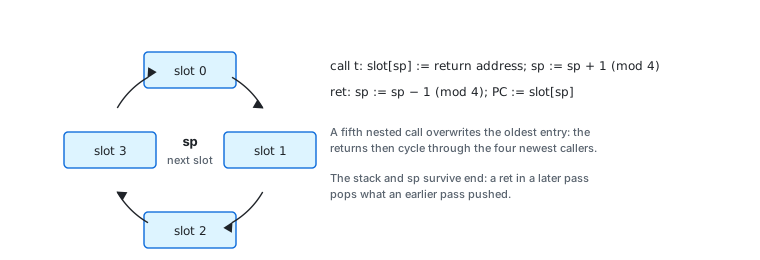
Figure 3-2. The DMP3 return stack
The return stack has four entries, used as a ring:
- A fifth nested call overwrites the oldest return address.
- The stack and its pointer survive
end: aretin a later pass pops what an earlier pass pushed. - A
retwith nothing pushed since DMP_RST returns to an undefined address.
        ; given 0x120 = 41i
        call    bump
        fmode   1
        call    bump
        fmode   1
        end
bump:   always
        fmode   1
        inc
        ret
        ; expect 0x120 = 43i
Ending a pass, and the interrupt
end (0xFF) ends the pass. Under a false predicate it is skipped, which makes a conditional end.
int raises the host interrupt (§1.5) and continues.
        int
        ; expect ints = 1
3.8 The Mode Register
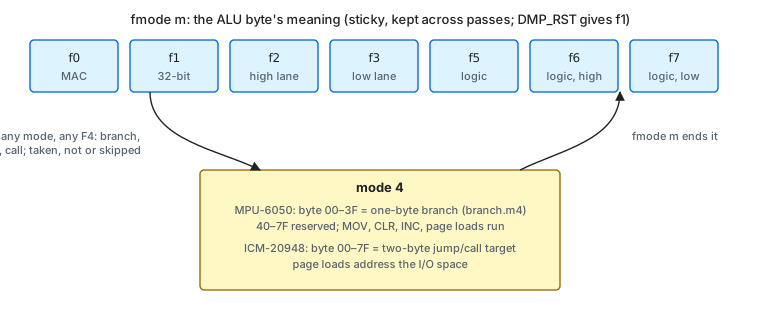
Figure 3-1. The mode register
fmode |
Byte | ALU byte means | Width |
|---|---|---|---|
| 0 | F0 | mac, macn |
32-bit |
| 1 | F1 | add, rsub, mul, nmul |
32-bit |
| 2 | F2 | add, rsub, mul, nmul |
high lane |
| 3 | F3 | add, rsub, mul, nmul |
low lane |
| 5 | F5 | clamp, cmp, and, xor |
32-bit |
| 6 | F6 | clamp, cmp, and, xor |
high lane |
| 7 | F7 | clamp, cmp, and, xor |
low lane |
| 4 | F4 | mode 4: no ALU (below) | — |
The mode register is sticky:
- It carries over into the next pass.
- After DMP_RST it holds 1.
- The lane width also governs MOV, MOVX, CLR, INC, DEC and
test.
Mode 4. Every F4 byte enters mode 4, whatever it does: a taken or untaken branch, jump or call,
an F4 skipped by a predicate, or a one-byte F4. The next fmode ends it. In mode 4:
| Bytes | MPU-6050 | ICM-20948 |
|---|---|---|
| 0x00–0x3F | branch.m4: one-byte branch |
the first byte of a jump.m4 target |
| 0x40–0x7F | reserved | the first byte of a call.m4 target |
| page loads | memory, as usual | the I/O space (§2.3) |
| everything else | as usual | as usual |
So after every branch, jump, call or return, the first instruction that needs a mode is an fmode.
The assembler tracks the mode and refuses an ALU instruction it cannot place (Chapter 8).